What Is Generative Engine Optimization (GEO)? 2026 Guide
Generative Engine Optimization (GEO) is how brands get named and cited inside AI answers from ChatGPT, Perplexity and Gemini. What it is, how it works, and how to start.
By Ved Prakash · Updated 2026-08-19
Generative Engine Optimization (GEO) is the practice of making a brand retrievable, trustworthy and citable to AI systems that generate answers instead of returning a list of links. Where SEO competes for a ranking position, GEO competes to be the brand a language model names inside its answer. It works through four levers: entity authority, off-site citation consensus, retrieval-ready content structure, and a sustained freshness cadence. GEO shares most of its technical foundation with SEO but diverges on off-site trust, which classic SEO barely touches.
Ask ChatGPT, Perplexity or Google's AI Overview a buying question and you get an answer, not ten blue links — and that answer names a few brands and cites a few sources. Generative Engine Optimization (GEO) is how you become one of those named brands. Searches for "what is generative engine optimization" have climbed roughly 120% year over year, because every business that relied on Google rankings now has a second visibility problem to solve. Here is what GEO is, how it works, and how to start.
What is Generative Engine Optimization?
GEO is the practice of optimizing a brand so AI systems retrieve it, trust it, and cite it when they generate answers. Traditional SEO competes for a position in a ranked list; GEO competes to be the brand a model names inside a generated answer. There is no position one in an AI answer — only which brands get mentioned and which sources get pulled.
That single difference changes what you optimize. In a ranked list, a better page can displace a competitor on the strength of that page alone. In a generated answer, the model isn't comparing your page to a competitor's — it is recalling which brands it associates with the question, then finding sources to support that recall. GEO is the work of building that association. (For the full comparison, see GEO vs SEO.)
GEO vs SEO vs AEO — the quick distinction
| SEO | GEO | AEO | |
|---|---|---|---|
| Competes for | A ranking position | Being named in an AI answer | Owning a specific direct answer |
| Level | Page | Brand / entity | Page + question |
| Primary lever | Relevance + backlinks | Entity authority + citations | Structure + FAQ schema |
| Where it shows | Google results | ChatGPT, Perplexity, Gemini | Snippets, AI Overviews |
The three overlap and are often sold together. Answer Engine Optimization makes a page quotable; GEO makes a brand memorable to the model. You generally need both.
The four levers of GEO
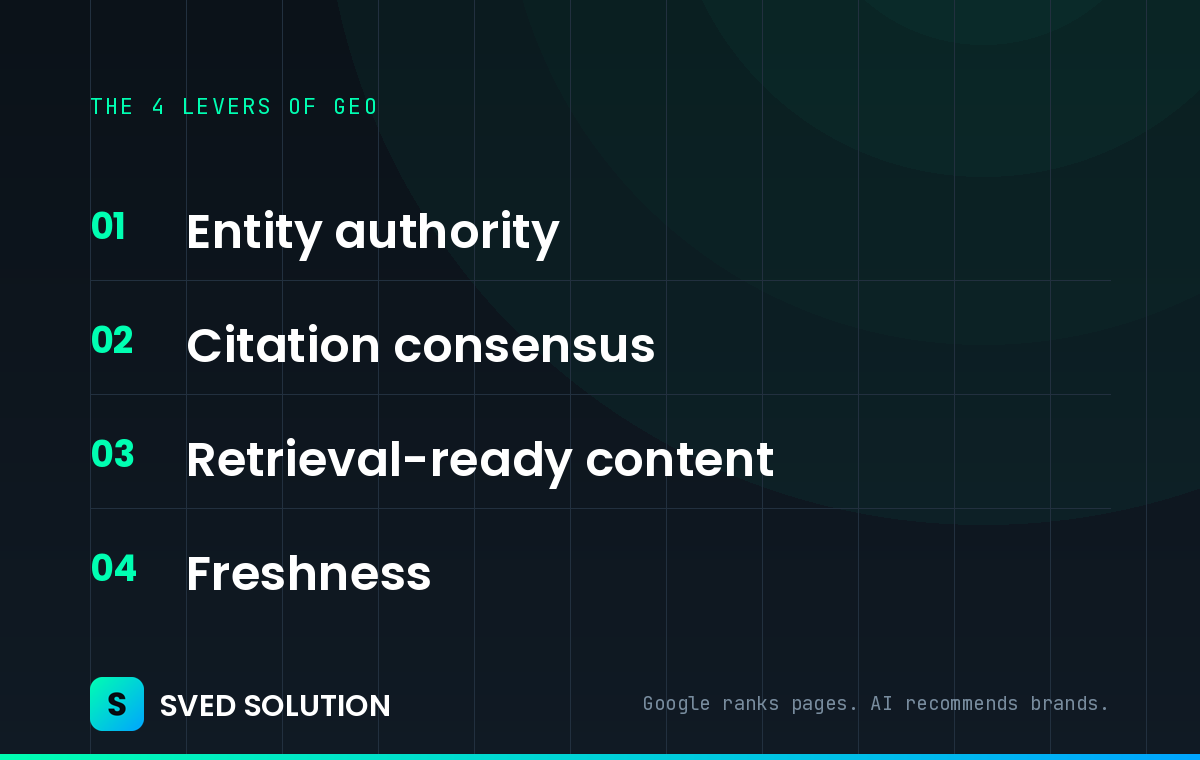
- Entity authority. The model must resolve your brand as a clear, consistent entity — one canonical name, one description, corroborated across the web. This is the foundation, and most sites fragment their own entity before anyone else does. It is the core of AI citation & entity building.
- Off-site citation consensus. When a model sees your brand described the same way across sources it already trusts, it treats that repetition as consensus. This off-site signal is the single strongest driver of whether you get named — and the one classic SEO barely touches.
- Retrieval-ready content. Answer-first pages, question-shaped headings, tables and clean structure so a model can extract and attribute a passage. Content that only appears after client-side JavaScript is often invisible to AI crawlers — a technical SEO and LLM SEO concern.
- Freshness. Recency is weighted, so cornerstone content is updated on a cadence with visible dates.
Why GEO matters now
AI answers increasingly sit above the traditional results and absorb the click. A brand that establishes entity authority early is the default the model reaches for; a brand that starts late is trying to displace an incumbent the model already trusts — which gets more expensive every quarter. The mechanics of getting cited are covered step by step in how to rank in ChatGPT.
How to start with GEO
Fix the technical foundation first (it is a prerequisite for both SEO and GEO), run AEO on your money pages for fast feedback, then run GEO continuously in the background — the slowest to show results and the most defensible once established. A realistic curve: entity indexing at 30–45 days, first citations around day 60, consistent mentions by day 90. No one controls these models and there is no submission process, so anyone guaranteeing a citation is guessing.
Frequently asked questions
What is Generative Engine Optimization in simple terms? It is SEO for AI answers: making your brand the one ChatGPT, Perplexity and Gemini name and cite when they respond, rather than one of ten links in a list.
Is GEO the same as SEO? No. They share a technical foundation, but SEO competes for a ranking position while GEO competes to be named inside a generated answer, driven mainly by entity authority and off-site citations.
How do you measure GEO? There is no rank to track. You measure citation frequency, share of voice against competitors, and which sources a model pulls — tested on a fixed prompt cadence across engines.
How long does GEO take to work? Entity indexing typically registers at 30–45 days, first citations around day 60, consistent mentions by day 90, and durable category authority at 9–12 months.
Can I do GEO myself? Parts of it — schema, answer-block structure and freshness are internal once the standard is set. The harder pieces are off-site citation building and controlled prompt testing at cadence.
The bottom line
Generative Engine Optimization is no longer optional — it is how brands stay visible as search shifts from links to answers. Build entity authority, earn citation consensus, structure content for retrieval, and keep it fresh. Start with our Generative Engine Optimization services or run a free AI visibility audit — twelve checks against your live URL, no card required.
Outsource your organic marketing to a specialist
SVED Solution is a 360° SEO and AI-visibility agency operating since 2018, helping brands get found on Google and named by ChatGPT, Perplexity, Gemini and Google AI Overviews. We run Generative Engine Optimization, Answer Engine Optimization, technical SEO, content and digital PR as one program, report AI citations as a measured number, and price for outcomes — consulting from $30/hour, with retainers scoped only after a diagnostic audit. If you want senior organic-marketing expertise, transparent reporting and global delivery without US-agency pricing, we are the team to outsource it to.
Find out where your own site stands.
The free audit runs twelve AI eligibility checks against your live URL in about sixty seconds.