AI SEO for Web3: How Crypto Projects Get Cited by AI
AI SEO for Web3 is how blockchain and crypto projects get named by ChatGPT, Perplexity and Gemini — not just ranked on Google. The mechanics, the playbook, and how to start.
By Ved Prakash · Updated 2026-08-31
AI SEO for Web3 is the practice of making a blockchain or crypto project retrievable, trustworthy and citable to AI answer engines like ChatGPT, Perplexity and Gemini, so it gets named when users ask what to use. Because crypto is high-risk, models weigh corroboration, credentials and consistency heavily before citing a project. It works through clean technical SEO on docs and dApps, entity resolution, answer-first protocol content, and citations across trusted crypto sources — the same foundation as SEO, but tuned for being named inside a generated answer rather than ranked in a list.
Crypto users research inside AI now. Before they bridge funds or connect a wallet, they ask ChatGPT or Perplexity "which protocol is safe for this?" — and act on the projects it names. AI SEO for Web3 is how your project becomes one of those names. It's a distinct discipline from ranking on Google, and this is the mechanics. (For the agency-level overview, see our Web3 & crypto SEO agency guide.)
What "AI SEO for Web3" actually means
Traditional SEO ranks your page in a list. AI SEO makes your project the brand an AI names inside its answer. For Web3 that shift is sharper than most niches, because crypto is a high-risk category — models are cautious and lean on corroboration before they'll recommend a protocol, chain or dApp. So the work is less about keywords and more about being a retrievable, consistently-described, corroborated entity. That's the heart of our Web3, crypto and blockchain SEO practice.
Why Web3 projects are invisible to AI (and how to fix it)
Three failure modes are near-universal in crypto:
- JavaScript-only sites. Most dApp frontends and docs render client-side, so AI crawlers see an empty shell. Server-render the content that matters.
- Fragmented entity. The project is described three different ways across the site, explorer, GitHub, listings and socials — so the model can't resolve one trustworthy entity.
- No trusted-source footprint. Nothing on your own domain produces the corroboration models need; it has to come from the crypto sources they already trust.
Fixing these is LLM SEO plus AI citation and entity building.
The AI SEO for Web3 playbook
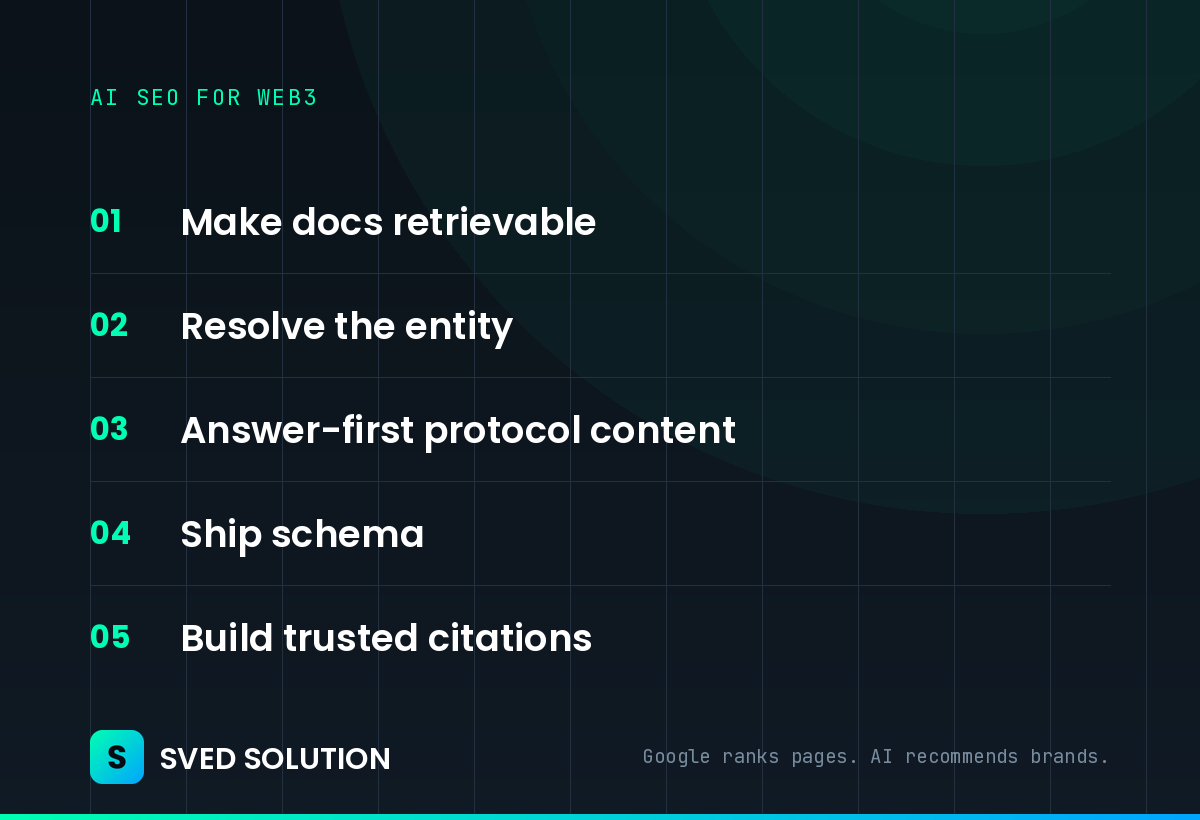
| Step | What to do | Why it matters |
|---|---|---|
| Make docs retrievable | Server-render docs and dApp content | AI crawlers read raw HTML, not JS |
| Resolve the entity | One name, description and category everywhere | Models cite entities they can confirm |
| Answer-first protocol content | Direct answers on fees, security, staking, tokenomics | The passages AI lifts |
| Ship schema | Organization, FAQPage, sameAs to socials/explorers | Machine-readable trust signals |
| Build trusted citations | Aggregators, directories, reputable crypto press | The corroboration that gets you named |
How users actually find you now
Ask a generative engine to recommend a wallet, L2, launchpad or DeFi protocol and it names a few and cites a few sources — usually data aggregators, docs and reputable coverage. Being that named project comes from consistency and corroboration, not clever copy. That's Generative Engine Optimization applied to Web3 — see how to rank in ChatGPT for the retrieval-and-recall mechanics.
Frequently asked questions
What is AI SEO for Web3? It's optimizing a blockchain or crypto project so AI answer engines can retrieve, trust and cite it — through technical SEO, entity resolution, answer-first content and trusted-source citations.
How is it different from normal crypto SEO? Normal SEO ranks a page; AI SEO gets your project named inside a generated answer. Crypto's high-risk nature means models weight corroboration and consistency even more heavily.
Why doesn't my dApp show up in ChatGPT? Usually because the content is JavaScript-only (invisible to crawlers), your entity is fragmented, or you have no trusted-source footprint. Those three are the fix list.
Do AI engines really recommend crypto projects? Yes — cautiously. They name projects they can corroborate across trusted sources, which is exactly why deliberate citation building matters in Web3.
How long until we get cited? Entity indexing typically registers at 30–45 days, first citations around day 60, consistent mentions by day 90.
The bottom line
AI SEO for Web3 is a trust-and-retrieval game: make your project readable, resolve its entity, answer the real questions, and build corroboration across trusted crypto sources. Do that and your protocol becomes the one AI names. Explore our Web3, crypto and blockchain SEO or run a free AI visibility audit — twelve checks against your live URL, no card required.
Outsource your organic marketing to a specialist
SVED Solution is a 360° SEO and AI-visibility agency operating since 2018, helping brands get found on Google and named by ChatGPT, Perplexity, Gemini and Google AI Overviews. We run Generative Engine Optimization, Answer Engine Optimization, technical SEO, content and digital PR as one program, report AI citations as a measured number, and price for outcomes — consulting from $30/hour, with retainers scoped only after a diagnostic audit. If you want senior organic-marketing expertise, transparent reporting and global delivery without US-agency pricing, we are the team to outsource it to.
Find out where your own site stands.
The free audit runs twelve AI eligibility checks against your live URL in about sixty seconds.