AI SEO for D2C & Ecommerce Brands: Get Cited by AI
AI SEO for D2C and ecommerce brands: how to get products found on Google and recommended by ChatGPT, Perplexity and AI Overviews. The playbook for 2026. Free audit.
By Ved Prakash · Updated 2026-08-31
AI SEO for D2C and ecommerce brands means optimizing product and category pages for both Google rankings and AI answer engines, so shoppers find your products in search and your brand gets named when they ask AI what to buy. It works through clean product and category technical SEO, Product/Review/FAQ schema, buying-guide and comparison content answered directly, and citation building across the review and marketplace sources AI trusts — so the brand is the one Google ranks and AI recommends.
Shoppers increasingly start with a question to ChatGPT or Google's AI Overview — "what's the best [product] for [need]?" — and act on the brands it names. For a D2C or ecommerce brand, AI SEO is now the difference between being on that shortlist and being invisible. This is the playbook to get your products found on Google and recommended by AI.
Why AI SEO is different for ecommerce and D2C
- Discovery moved upstream. Buyers ask AI for recommendations before they browse a store or a marketplace. If your brand isn't named, the sale is often decided before you enter the funnel.
- Trust signals are decisive. AI models lean on reviews, ratings and consistent third-party mentions — the exact signals a D2C brand competing with marketplaces must build deliberately.
- Catalogue scale is a technical challenge. Faceted navigation, variants and thin category pages create crawl and extraction problems that quietly cap visibility.
That's the focus of our ecommerce and D2C SEO work.
What our AI SEO for D2C & ecommerce covers
| What you get | The service | Outcome |
|---|---|---|
| Get named by ChatGPT, Perplexity & AI Overviews | Answer Engine Optimization + AI citation building | Your brand is recommended, not just listed |
| Rank product & category pages | Technical SEO + Product/Review schema | Qualified shopping traffic |
| Buying guides AI quotes | Content strategy | Top-of-funnel demand that converts |
| A brand AI trusts | Citation building on review sources | The corroboration models reward |
The shift: shoppers ask AI what to buy
Ask a generative engine for the best running shoe, skincare routine or coffee maker and it names a handful of brands and cites a handful of sources — reviews, guides, marketplaces. Being that named brand comes from Product and Review schema, comparison content answered directly, and consistent citations across trusted review platforms. That's Generative Engine Optimization applied to retail. For the mechanics, see how to appear in Google AI Overviews.
The D2C & ecommerce AI SEO playbook
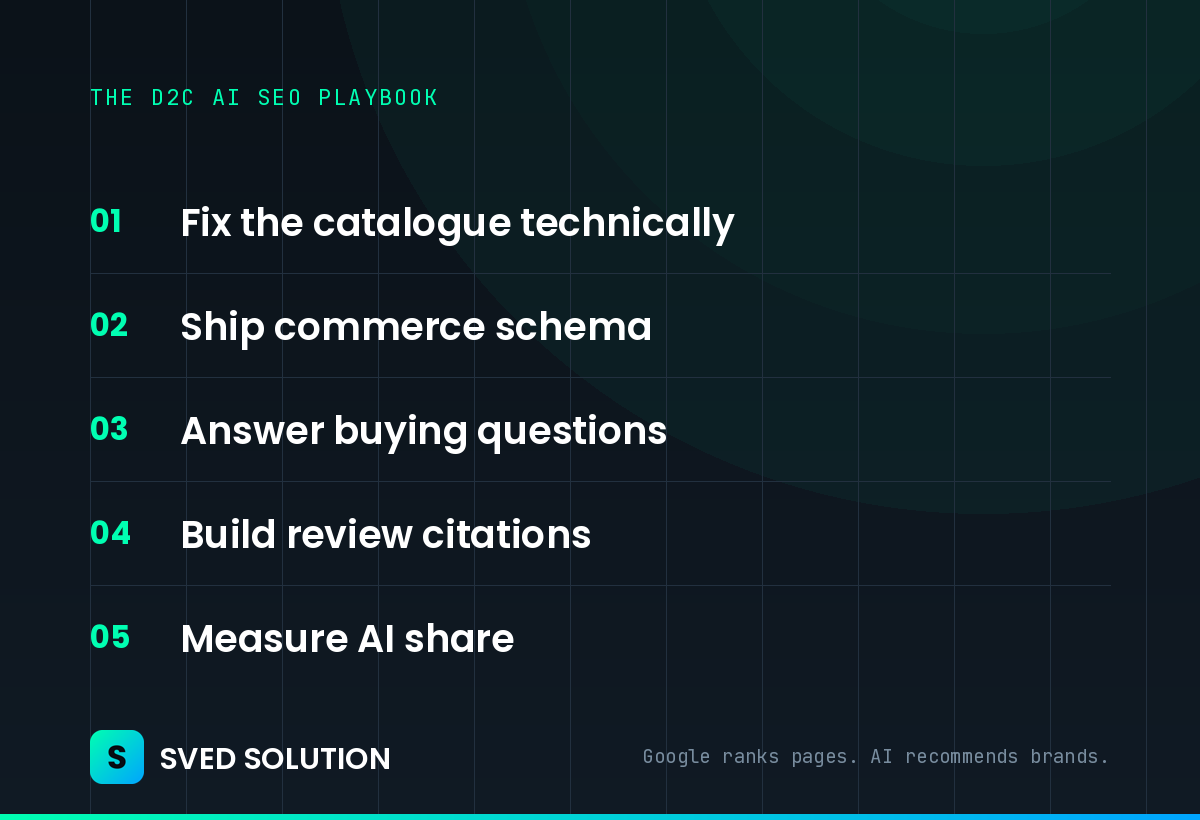
- Fix the catalogue technically. Control faceted navigation and variants, kill index bloat, and make product content server-rendered and fast.
- Ship commerce schema.
Product,Offer,ReviewandFAQPageso Google and AI understand price, availability and rating. - Answer buying questions. Comparison and buying-guide content that opens with a direct answer — the format AI quotes.
- Build review-source citations. Consistent presence and description across the review platforms and marketplaces models trust.
- Measure AI share. Track how often AI names your brand for category prompts, on a fixed cadence.
Frequently asked questions
What is AI SEO for ecommerce? Optimizing product and category pages for Google and AI answer engines — technical SEO, commerce schema, buying-guide content and citation building — so shoppers find your products and AI recommends your brand.
How do D2C brands get recommended by ChatGPT? Through consistent reviews and third-party mentions, Product/Review schema, and comparison content answered directly. Models weight independent corroboration heavily for purchases.
Is AI SEO worth it for a small D2C brand? Yes. Being named by AI for even a few high-intent category prompts can drive qualified demand, and the work compounds unlike paid ads.
Does this work for brands in India? Yes — India's fast AI adoption means shoppers here reach for AI recommendations early, so brands optimizing now get the head start.
How long before results show? Product and category improvements typically move in 60–90 days; AI citations follow the standard curve — entity indexing at 30–45 days, first citations around day 60.
The bottom line
For D2C and ecommerce, AI SEO is about being present where shoppers now decide — Google and AI answers. Fix the catalogue, ship commerce schema, answer buying questions, and build review-source citations. Explore our ecommerce and D2C SEO or run a free AI visibility audit — twelve checks against your live URL, no card required.
Outsource your organic marketing to a specialist
SVED Solution is a 360° SEO and AI-visibility agency operating since 2018, helping brands get found on Google and named by ChatGPT, Perplexity, Gemini and Google AI Overviews. We run Generative Engine Optimization, Answer Engine Optimization, technical SEO, content and digital PR as one program, report AI citations as a measured number, and price for outcomes — consulting from $30/hour, with retainers scoped only after a diagnostic audit. If you want senior organic-marketing expertise, transparent reporting and global delivery without US-agency pricing, we are the team to outsource it to.
Find out where your own site stands.
The free audit runs twelve AI eligibility checks against your live URL in about sixty seconds.